

The South Korean aerospace, space, and defence sectors have experience rapid development in recent years. High ambitions and major innovations are driving forces behind the country’s progressive development in these sectors.
KASA (Korea AeroSpace Administration) was established in May 2024 to unify the country’s space policies and projects, ensuring the sectors more streamlined and connected for better success. KASA has established a robust budget of KRW 964.9 billion (approximately USD 665 million) for the year 2025, representing a 27% increase compared to the previous year.
The market size of the relevant sectors in Korea is projected to reach USD 7.64 billion by 2030, reflecting a Compound Annual Growth Rate (CAGR) of 9.38%. The country aims to be a powerhouse in the industry by 2045; by blending defence, space, and commercial aviation into a high-tech ecosystem with a substantial investment of 100 trillion won (USD 72.6 billion).
The 2025 budget allocation by KASA underscores the government’s strategic focus across five priority areas. The largest share, USD 214 million, is directed toward space transportation, highlighting Korea’s commitment to establishing sovereign launch capabilities. This is followed by an allocation of USD 146 million for advanced satellite development, reinforcing efforts to enhance domestic satellite technologies. The remaining key focus areas include fostering the private space industry ecosystem, advancing lunar exploration initiatives, and supporting participation in the Square Kilometre Array Observatory (SKAO).
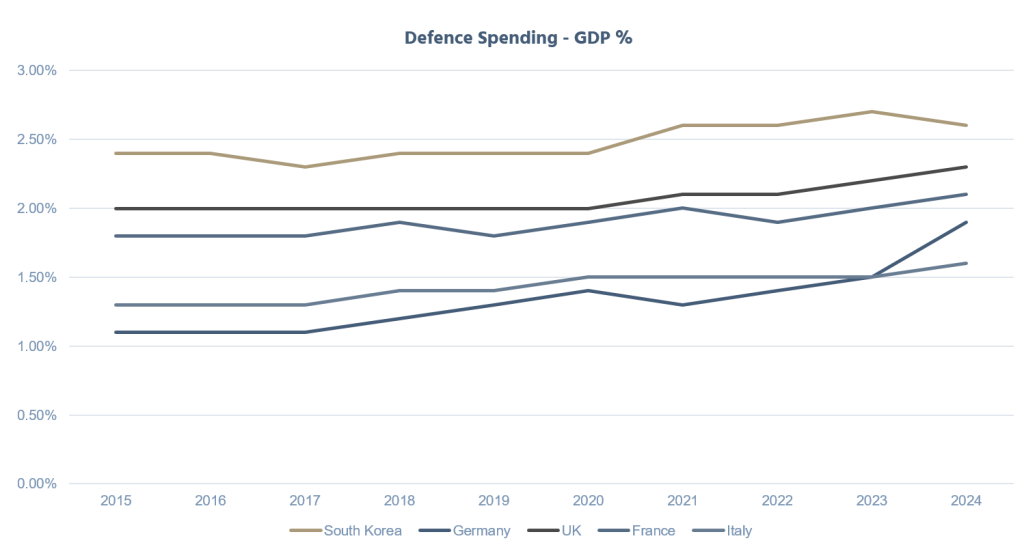
South Korea has maintained a higher defence spending percentage of GDP with a consistent upward trend since 2020. A steady spending of over the 2.5% mark can be observed as opposed to leading EU economies such as Germany, UK, France, or Italy.
Major Innovations and Projects
Nuri (KSLV-II) is South Korea’s first indigenously developed three-stage orbital launch vehicle had its first test flight in 2021. By 2023, it completed multi-satellite deployment, marking Korea’s first fully successful domestic orbital insertion with KARI-developed hardware. 3 more launches are planned in the coming years: October 2025, 2026, and 2027.
KSLV-III Next-Generation Launch Vehicle is a medium-lift geostationary transfer orbit launcher under development with reusable design elements, funded by a development budget of 2.13 trillion won (USD 1.56 billion) between 2023 to 2032. During this period, there are a few planned missions including lunar orbit insertion (2030), soft-landing verification (2031), and final lunar lander launch (2032).
Hanwha Aerospace, Innospace, Perigee Aerospace, Unastella are some other notable names in the aerospace industry paving their way in the country. Multi-billion-dollar deals were even secured by Hanwha Aerospace with Poland.
Upcoming Events
There are two upcoming conferences that may also be helpful if you are keen in exploring business opportunities in the industry: Korean Space Science Society (KSSS) in October, and Korean Society for Aeronautical and Space Sciences (KSAS) in November 2025.
Join Our Webcast!
If you want to learn more about South Korea’s aerospace, space, and defence sectors, or are interested in getting involved, Melchers Korea is having an insightful webcast on the topic on 21 August 2025 @ 2pm CET. Join for free, with no obligations for a 30-minute session: Unlocking Opportunities in the Korean Aerospace and Defence Market. Register now to receive event reminder or add to calendar so you do not miss it!
Reach out to Melchers Korea’s Business Development Manager, Francesco Mercurio, who will be happy to assist you with any questions on the webcast topic, if you are keen in joining the conferences, or for other business opportunities in South Korea.
